
AI & Creative Teams: Are We Having the Right Conversation?
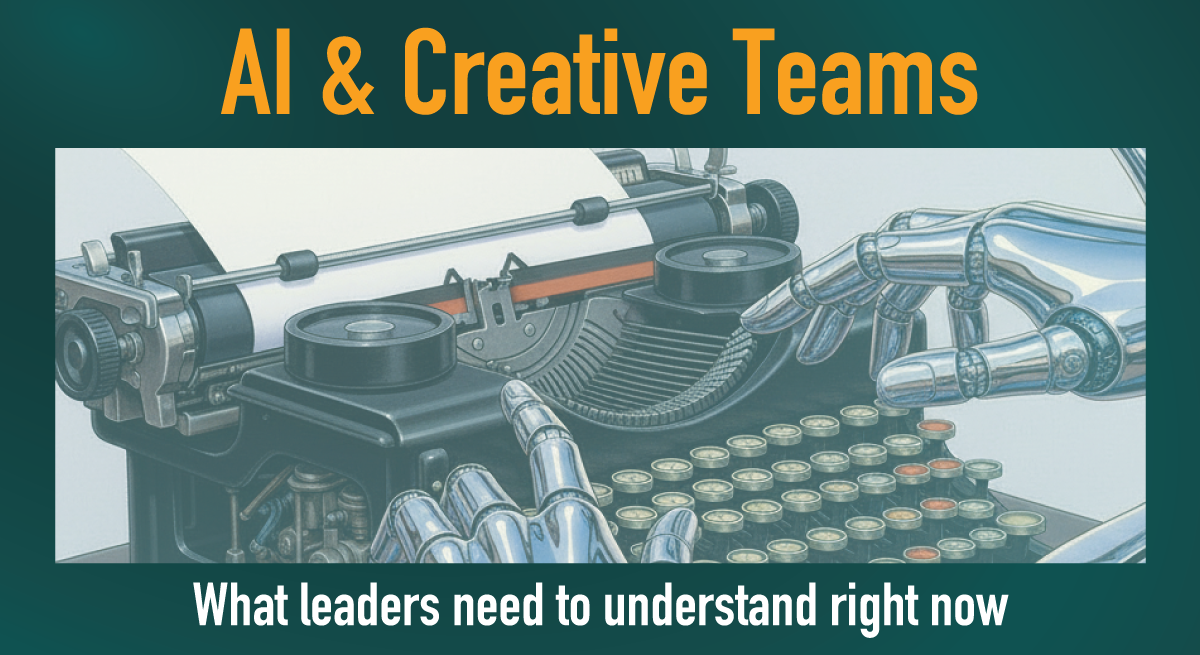
A couple of weeks ago, I wrote about how AI is reshaping the daily reality of creative professionals. The short version: AI isn’t replacing storytellers, but it is changing the environment they work in. That conversation sparked a different question from several readers; not about the creatives themselves, but about the people who hire, lead, and depend on them. Because AI isn’t only changing the tools; it’s changing what leadership must look for, encourage, and protect within the organization’s narrative. Many teams aren’t struggling because they lack talent; they’re struggling because the tools are evolving faster than the structures built to support them. This piece is for the leaders navigating that shift.
For years, many creative teams were organized around the idea that everyone owned a single square on the board. Writers stayed in the writing square, designers in the design square, strategists in the strategy square, each working within the boundaries of their discipline. That structure made sense when the work moved more slowly and the lines between roles stayed clear. But today’s environment doesn’t behave that way. The real advantage now belongs to people who can see the entire board instead of just the piece in front of them. Creative generalists, once undervalued or misunderstood, have become the steadying force that keeps the work aligned. Not because they “do everything,” but because they understand how the squares interact and where the story can fall apart. If you’re leading a team, the question isn’t who your strongest specialist is; it’s who can see the pattern others miss because they’re too deep inside their own square.
This shift brings a structural challenge into sharp focus. Many organizations are still operating with pre-AI playbooks that separate functions and expect clarity to emerge from the handoff between tightly defined roles. But AI has blurred the lines between writing, design, research, planning, and strategy; those squares now overlap whether teams are ready for it or not. When companies hold fast to older models, they often end up with more output but less coherence. The team gets faster at producing things, yet slower at producing meaning. Leaders see increased activity and assume it signals progress, even when the message is drifting or losing shape.
A former colleague’s recent project illustrated this tension clearly. A client had commissioned a short video from an external contractor. The final file looked polished on the surface: clean transitions, tight timing, solid pacing. But when they asked for the project files so the piece could be adapted for different platforms, they discovered there were no source materials at all. No editable graphics, no layered text, no design artifacts. Everything had been generated through AI-driven tools that provided only a flattened final video. What looked efficient on the surface created a downstream problem; the content was impossible to iterate on without starting over. It was a perfect example of what I have started to think of as the Output Surge Problem. The work was produced quickly, but the shortcuts erased the intermediate thinking that makes creative work flexible and reusable. Leaders often don’t discover this until they need to adapt something that was never built to evolve. If someone had been empowered to see the whole process, this could have been avoided.
At the same time, organizations are rethinking how they staff their teams. Several companies I’ve worked with recently have been candid about their internal bandwidth challenges. Their teams weren’t lacking talent, but every project demanded some combination of writing, design, planning, and strategic interpretation; skills that no single specialist could reasonably own alone. Instead of adding full-time headcount they didn’t need, many began working with flexible external talent: freelancers, remote creatives, and fractional senior leaders who could fill gaps, bring broader creative literacy, and help the team move more fluidly across disciplines. What surprised them most wasn’t the extra capacity; it was the clarity that came from having someone who could translate across specialties. Remote work often strengthened that effect. The person had enough distance from old processes to help the team modernize how they worked, not reinforce outdated habits. This model is becoming more common as leaders look for ways to update their teams without rebuilding an entire org chart.
All of this feeds into a larger leadership challenge. AI makes it incredibly easy to produce content, and just as easy to produce content that misses the mark. The real gap emerging isn’t ability; it’s judgment. Quantity is rising while quality becomes less predictable, and the difference between the two is widening quickly. The ability to decide what should be made and what should not has become one of the rarest skills on a team. Leaders who thrive in this era will stop measuring output and start assessing discernment. Which ideas get prioritized? Which get set aside? Where does automation help, and where does it distort the message? What does the organization stand for, and does the work reflect that? AI can generate content, but only people can generate coherence. Leaders who focus solely on speed will end up producing more and more messages that matter less and less.
As you evaluate your own team, here are a few considerations that tend to separate strong creative organizations from the ones that struggle:
1. Don’t confuse “AI-powered” with strategic value. Tools are useful, but people create clarity.
2. Hire thinkers, not just technicians. Execution can be automated; insight cannot.
3. Put trust at the center of how you evaluate creative work. In a world full of polished outputs, credibility matters more than cosmetics.
4. Reward people who ask the uncomfortable questions. They’re the ones preventing expensive mistakes.
5. Invest in coherence. A consistent voice, story, and visual system will outlast every new tool that arrives this year.
Leaders face a simple choice right now: use AI to strengthen your signal or unintentionally add to the noise. How you structure your teams, choose talent, and support your communicators will determine which one you get. I’d love to hear how this shift is unfolding inside your organization: what’s working, what’s changing, and where you see opportunity. These conversations ultimately shape the next chapter of this story.